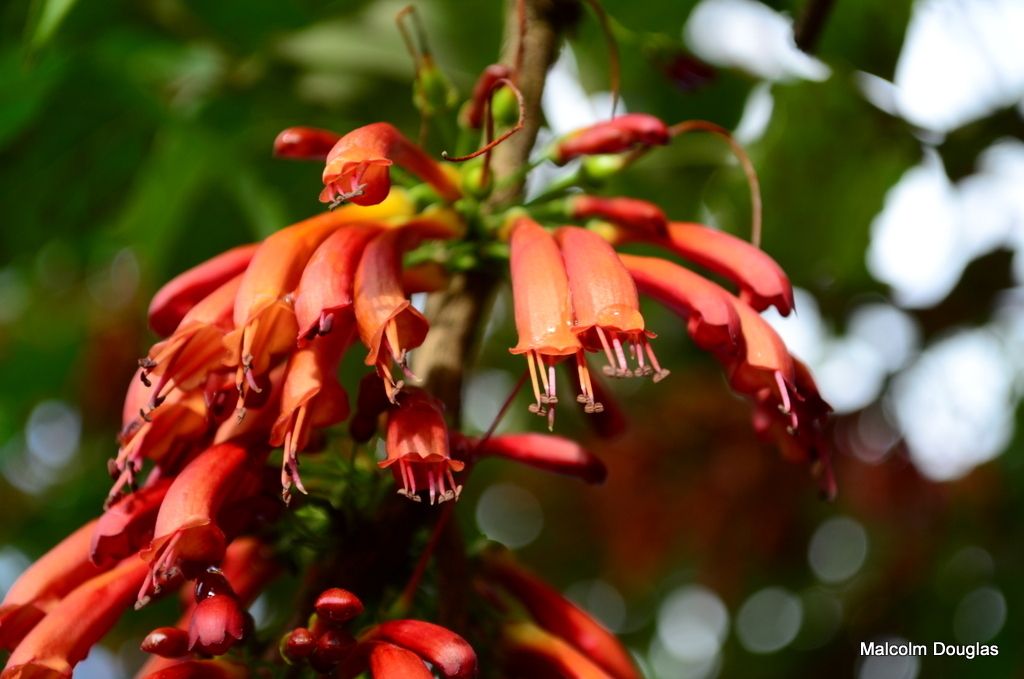
Braamfontein Spruit Ecological Corridor

(c) Malcolm Douglas, some rights reserved (CC BY-NC), uploaded by Malcolm Douglas

Milk-ball

Halleria lucida

Animal-friendly

Supports birds Supports birds
Supports sunbirds Supports sunbirds
Supports bees Supports bees

Tolerances & suitability

Good potplant Good potplant

Growth features

Easy to grow Easy to grow

Social features

Useful Useful
Medicinal Medicinal
Edible Edible
Attractive Attractive

Aspect

Sun Sun
Semi-shade Semi-shade

Plant types

Shrub Shrub
Tree Tree

Succession

Pioneer species Pioneer species

Flowering

  • orange
  • red
  • yellow
Sep Oct Nov Dec

This is a very useful plant for many reasons and is also easy to grow. It attracts fruit- and nectar-loving plants and has medicinal value and as a charm against evil. It was also once valued for wagon poles, tools and spear shafts and is still useful for starting fires by friction. You can grow this tree as a hedge and in a pot as well.

Sunny spot preferred; Forest, Mtn Fynbos. Size: Medium

Propagation by seed

"Halleria lucida is easily propagated by seed, and cuttings. Seed is best sown in spring to mid-summer (September to December) or in autumn (March to May), in a standard well-drained seedling mix and covered lightly with coarse sand or milled bark. The trays can be placed over bottom heat of 25 °C although this is not essential for germination to occur. Seed should germinate within 6 weeks. Seedlings can be transplanted as soon as they are large enough to handle."

Propagation by cutting

"Can also be propagated by truncheon cuttings or layering and transplants readily. Softwood or herbaceous cuttings, or heel cuttings should be taken from actively growing shoots in spring to early summer (September to November) or in autumn (March to May), treated with a rooting hormone and placed in a propagator with intermittent mist and bottom heat of 28 °C. Rooting should occur within 6 weeks, and the newly rooted cuttings require a weaning period of 1 month. Young plants may flower for the first time in their second year.

Sources and references

Start planning your restoration garden