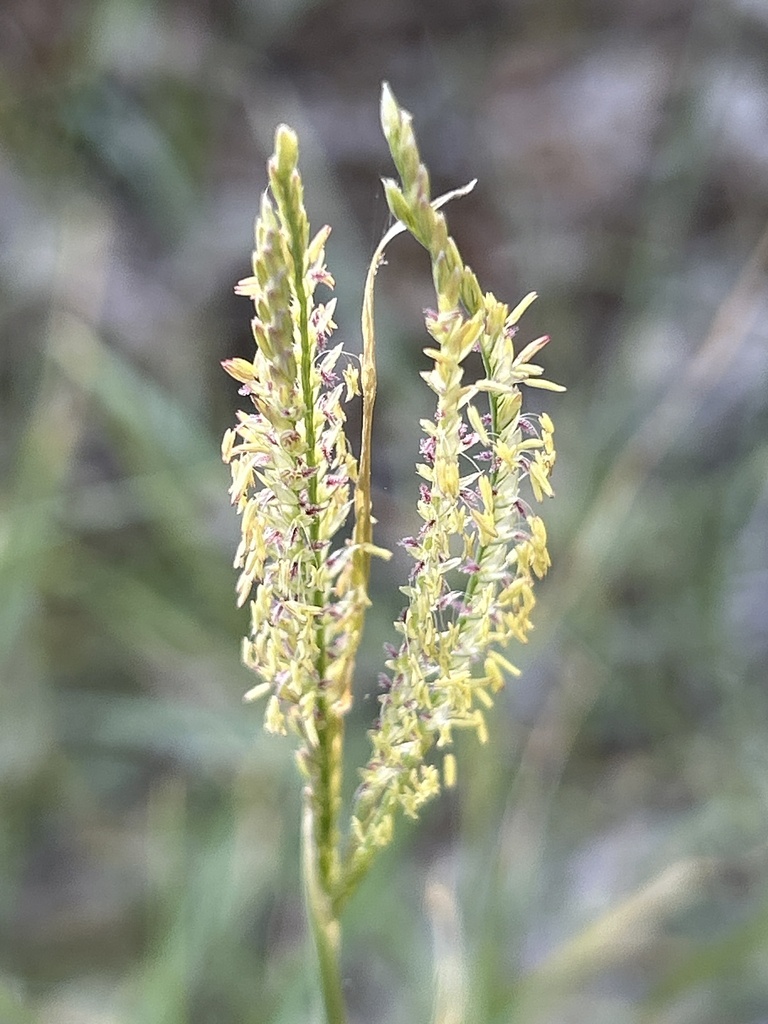
 © (c) Rozetta Locksa, some rights reserved (CC BY-NC), uploaded by Rozetta Locksa (CC-BY-NC)
Bermuda grass
Cynodon dactylon
Wildlife supported
Tolerances & suitability
Growth features
Succession
Flowering
- green
- yellow
Cynodon dactylon, commonly known as Bermuda grass, also known as couch grass in Australia and New Zealand, is a grass found worldwide. It is native to Europe, Africa, Australia and much of Asia. Contrary to its common name, it is not native to Bermuda and is in fact an abundant invasive species there.
The blades are a grey-green colour and are short, usually 2–15 cm (0.79–5.91 in) long with rough edges. The erect stems can grow 1–30 cm (0.39–11.81 in) tall. The stems are slightly flattened, often tinged purple in colour.
The seed heads are produced in a cluster of two to six spikes together at the top of the stem, each spike 2–5 cm (0.79–1.97 in) long.
It has a deep root system; in drought situations with penetrable soil, the root system can grow to over 2 metres (6.6 ft) deep, though most of the root mass is less than 60 centimetres (24 in) under the surface. The grass creeps along the ground with its stolons, and roots wherever a node touches the ground, forming a dense mat. C. dactylon reproduces through seeds, stolons, and rhizomes. Growth begins at temperatures above 15 °C (59 °F) with optimum growth between 24 and 37 °C (75 and 99 °F); in winter or in the dry season, the grass becomes dormant and turns brown. Growth is promoted by full sun and retarded by full shade, e.g., close to tree trunks.
Medicinal value
The rhizomes are reported to act as a diuretic in humans and the grass juice can act as an astringent.
It has been observed that Cynodon dactylon may be selectively eaten by dogs to swiftly induce vomiting when they have gastrointestinal problems. The effect may be due to irritation caused by bristles on the leaf margin.
Other
It is fast-growing and tough, making it popular and useful for sports fields, as when damaged it will recover quickly. It is a highly desirable turf grass in warm temperate climates, particularly for those regions where its tolerance to heat and drought enable it to survive where few other grasses do. This combination makes it a frequent choice for golf courses in South Africa. It has a relatively coarse-bladed form with numerous cultivars selected for different turf requirements.